Changing the Recipe

Coming up I’m going to post a 3-entry blog carnival dedicated to a new book published in April that I think everyone should read.

Reading books like Change the Recipe has always been a gift of joy and inspired living for me.

In all ways and from disparate sources I glean the information I can use to better myself. In turn I seek to help readers followers and audience members better themselves by sharing this information.

Maybe my life ethic shouldn’t be a surprise as I obtained a master’s in library and information science decades ago.

Like Mary Oliver asked famously in a quote:

Tell me what is it you plan to do with your one wild and precious life?

Finding out and going and doing what calls out to you could help a person Enjoy Life when they struggle.

I chose to devote my life to public service.

The goal I have for reviewing books in here is to inspire followers that the keys to self-development are right in front of our eyes.

Read on for a review of the latest book that changed my life.

Getting a Job After College

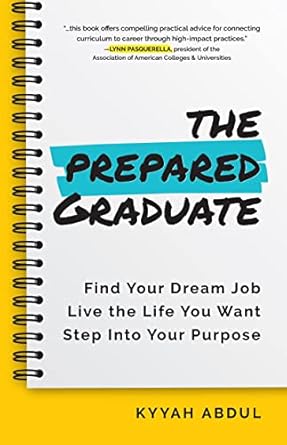
The book above the Prepared Graduate I recommend to every college freshman to read to be proactive while in school. Instead of being reactive after you get the degree.

One thing I take issue within a big way: she gives a sample pitch letter to send a person on LinkedIn in an attempt to snag an internship.

No—not at all should your first sentence be: Hope you’re doing well. It should refer to a new achievement of theirs and talk about why this victory impresses you.

(I learned this in a Zoom event the Roadmap Coach Christina Bryan hosted for leveling up your presence and persona in your career.)

Then the pitch should list how it would benefit them to hire you as an intern. To infer that doing so will enhance their reputation not just score you a job post-graduation.

After this you can list your school and your major. It’s the same thing as asking for 10 or 15 or 20 minutes of a person’s time to talk about questions you have about the field and line of work (traditionally called an information interview.)

Like I wrote 2 years ago in Working Assets your sales pitch should be about how you can help them with a project near and dear to their heart.

The one last issue I have is with the end of the subtitle attesting that you will be able to Step Into Your Purpose.

Should a 22 year know their life’s purpose so early in their lifetime on earth this time around? I would say this is where creating an Action Grid while in school or collecting SSI or SSDI can help. I talked about the Action Grid in Working Assets my career guide.

The subtitle should be “Step Into Your First Purpose” as in your first purpose at this stage of your life. In my last semester of college, I only wanted to publish books and invest in the stock market and travel to Sicily.

Still told The Prepared Graduate has other winning advice. The number one call out is getting a job related to your major while in college. Instead of taking any old job like flipping burgers to pay your bills. What if you can’t get an internship or job linked to your career while studying?

Be creative. Teach yourself a skill it would impress a hiring manager to know that you have. Start a professional podcast on the subject you’re studying for. Keyword in that sentence: Professional. Join a club on campus linked to the career—like the Student Marketing Association if you’re getting a degree in the field of marketing.

Plus, a professional organization devoted to your career might have a student membership option. Join—as the fee can be lower for a student.

Working Hard at a Job

In here before I’ve reviewed the book The Pomodoro Technique about a time management strategy for completing tasks at a job or elsewhere.

You set a kitchen timer for 25 minutes in which to work on part of a project. When the timer goes off you set it for five minutes in which to do nothing and rest.

Then set the timer for a new 25 minute time period. Use 3 or 4 “pomodoros” in the morning and 3 or 4 “pomodoros” in the afternoon.

The author of the book and creator of this technique had used a kitchen timer in the shape of a tomato. He is Italian and pomodoro is Italian for tomato. Sounds so much better than The Tomato Technique right?”

I think using pomodoros is an effective way to pace yourself throughout the workday and not get frazzled. The Pomodoro Technique is a way to work hard in the right way.

Research indicates that the more hours you work at a job every week over 40 hours the less productive a person is. The goal should not be warming a chair for 50 hours. It should be doing your best work within an 8 hour workday routinely. With little need for overtime. Except maybe during a crunch period like the launch of a new product.

Too each of us workers should take one break in the morning and one break in the afternoon. Even if the break is just 15 minutes.

One career strategist years ago recommended taking a 2-hour lunch on your job. I wouldn’t go that far unless you’re networking at lunch or meeting a client.

Coming up in the next blog entry a review of a book for college students who would like to get a job after they graduate. In keeping with my love of library work the author of this book urges young people to find a job that reflects their life’s purpose.

One Alternative Career

I think that a job in a library could be one great alternative career.

For decades I haven’t been a fan of thinking the only job you should get is in a corporate office.

Working in a public library the pay might not be great however the benefits could be better. Like getting a pension. And the opportunity to open up a 403(b) as an additional source of retirement income.

A 403(b) is the non-profit sector equivalent to a 401(k).

The benefit of a public library job is that it’s a pre-set 7 hours-only workday. You can show up in Converse high-tops or combat boots.

In a future blog entry I will talk about a library job in more detail.

You should be interested in working with people. It would help to be chatty at the customer service desk.

You can host programs like arts-n-crafts or a writing workshop.

A library job can often be a union job too. I’m so not a fan of working in a corporate office.

In the coming blog entry I’ll talk about the right way to work hard at any job. You want to be able to get ahead without losing your head.

Loving Our Jobs

In my career guide Working Assets I make one specific positive distinction:

It’s possible to have a job you love. Even if you’re not doing what you love on the job.

To wit:

You might not want to become a professional chef in a kitchen with all the demands. Instead you can bake cakes for coworkers to bring to your job to share in the staff kitchen.

I think everyone should buy and read a copy of Working Assets by the way. It’s on Amazon. The competitive information tells readers everything you need to know.

In my view it’s foolish not to ask for professional help when creating your resume. Ninety-five percent of the first draft resumes other people create to give to me for a review are terrible.

With 2 simple changes the resume can go from awful to AWEsome. Trust me. Staff at a public library are often trained to help patrons create resumes and conduct job searches.

It’s a FREE service that doesn’t cost you a dime. Unless you donate money to the library as a charitable contribution.

So–how can a person find a job they love. It could take trial and error. Yet it shouldn’t take 9 years like it did for me to realize that I shouldn’t be working in corporate offices!

In Working Assets I talk about creating a short-term Action Grid to figure out what kind of job you’d like to work at.

In a coming blog entry I’m going to focus on non-traditional workplaces.

In a future blog entry like I referred to before I will write about working hard the right way on a job.

The Truth About DEI

The fact that companies instituted DEI efforts tells us something. In June 2022 I checked out of the library and read 5 DEI business books one right after the other.

I propose that the remedy falls on White coworkers and coworkers of color to come together. The scarcity mentality that exists keeps people competing against each other for self-gain. We should come together because everyone’s in the same lifeboat holding on for dear life.

Any DEI efforts should first be initiated coworker to coworker regardless of our skin color. All coworkers should feel like we have equity or ownership in the outcome of our work projects.

There’s no cause for a coworker to gaslight you or me or to sabotage our work.

It starts with us–with you and me treating every coworker the right way. Banding together on the job to agitate for worker’s rights. It’s like the suspicious packages credo in the NYC subway system that mandates: “If you see something, say something.”

We should not fear retaliation for coming to the aid of coworkers or for fighting against workplace injustice. This issue of being laid off is a real thing though.

Perhaps what we really need along with an emergency fund is a “see you later” account. So that we can speak out and survive financially.

Really DEI begins long before any of us starts our first job. It hinges on widening our circle of friends. Being aware of what’s going on beyond our own lives. Checking a non-fiction book out of the library to read about these topics.

Twenty-five years ago in a Library Management course in graduate school I was already thinking about workplace dynamics. I chose for my term paper to write about how to reward workers for a job well done. How managers could motivate workers.

Giving staff members five 3 x 3 inch sheets of origami paper to “rekindle from burnout” doesn’t cut it.

In coming blog entries I’ll talk about finding a job you’ll love waking up to go to in the morning.

So, You Want to Talk About DEI

Countless anti-racist books have been published–even one listed on the front cover as a National Bestseller. How can that have been a bestseller if Americans voted into office a president who ended DEI efforts in the government.

Coming soon the Supreme Court taking on and trouncing cases involving DEI. The Supremes will rule against DEI efforts just like they ended the protections of Roe v. Wade. It’s only a matter of time.

Acting to obtain a just and fair outcome is everyone’s right and in fact a duty. Are DEI efforts still necessary today? I think DEI efforts fall on White staff standing up for Black coworkers and Black Americans everywhere.

No one wins in a “color-blind” America when a White person tells their friends or others that they don’t see race. Our skin color colors our experiences in life and what we go through navigating daily life. No one should have to “code-switch” to make White people comfortable.

In 1992 I stopped doing business with a racist gym membership director. In 2011 I stopped doing business with a racist real estate agent. Nineteen years later it was the same song and dance.

To remain in denial that racism exists is a mistake. The counter-effort is that each of us can choose what we think about and how we act toward others. Hate is learned or a person chooses to hate.

Each of us can decide to do the right thing. Instead of living solely for self-gain we can come together to advocate for each other’s rights. Instead of protecting our own interests and not caring about people outside our tribe. We can expand our worldview to give others dignity. Instead of seeing everything in life as being about the almighty dollar sign and whether we’re getting our fair share of the Benjamins.

Target halted their DEI efforts. Likely because the current president ended DEI initiatives in the government. You bet Target doesn’t want the president to end giving the company tax breaks if Target kept DEI in place. You want tax breaks you’re going to do what the the president says.

Getting back to whether DEI efforts are still necessary today. In the coming blog entry I’m going to talk about DEI in the workplace. Like everything else I write about I have radical ideas about this topic too.

To end here with the fact: Researchers created two identical resumes to submit to job postings. The only difference was that one resume had a Black-sounding person’s name. The other resume had an obviously White person’s name. Only the White person was called for an interview.

This was circa 2017. I should hope things have changed in 2025. That Black job candidates are getting their feet in the door. The trick is that once any of us of any color or creed gets past those velvet interviewer ropes it’s often game over for employees of any color or creed once we’re on the job.

So, I’m going to talk next about DEI in the workplace. Then in future blog entries write about finding a job you’ll love getting up in the morning to go to.

Calling Out Capitalism

I’m going to “stay in my lane” talking about how us peers can be well and recover whatever the political climate. The fact is that everyone loses not just Black American workers playing the zero-sum game of late-stage capitalism. Though this has been the scenario for too long I trust that advocates for worker’s rights can turn the tide in our favor.

While this might be true about capitalism I remain a fan of getting a job you love waking up in the morning to go to. More on what this type of job could be in a future blog entry.

Here today I just would like to write about something I read in a book. It was a quote from comedian Chris Rock who said that it’s not progress that Barack Obama was our first Black president. Rock retorted that Black persons have been qualified to be president for 100 years.

In the current political climate I think everyone should band together. We cannot expect the government to help ordinary Americans. I’m not a fan of either Liberals or Conservatives.

I didn’t think Joe Biden was the best we could do. The current president is thinking of giving Americans 20 percent of the money he cuts from government spending. I call that a poison pill disguised as Sweet Tart candy.

Democratic candidate Andrew Yang would’ve given every American citizen 18 and older a monthly not one-time payment of a $1,000 Universal Basic Income or UBI. Other world countries give their citizens a UBI.

Our elected leaders pressed and pushed will enact laws that benefit Americans. This is often a slow drawn-out process. That’s why I’m not a fan of relying on or waiting on the government to help us.

The idea of working at a job you love has been universally denounced by authors of worker’s rights books. I beg to differ in championing finding and succeeding at a job you love. As there are building porters who love their jobs and work with dignity and provide for their families. Custodians in public libraries clean and sweep and mop.

Whoever works wherever all of us should be treated right by management and customers alike. For today I will end here by writing that I’m going to talk in a future blog about how working hard is not to be frowned on. I’ll detail the method for working hard the right way. Without exhausting yourself and getting fatigued.

Case Study: Ashley Smith Part Three

Case Study: Ashley Smith Part Three

Give us ideas on how to cope with setbacks and bounce back. It couldn’t have been all sunshine for you every day. How can we survive the rainfall to see the rainbow?

When I was diagnosed, my doctor recommended two pieces of advice: 1) control my stress and 2) take my medication. Over the years, I’ve worked closely with doctors and therapists to uphold effective treatment plans. In addition to working with my health team I’ve developed self-care rituals to help me stay accountable to my wellness demands.

I encourage you to consider counseling and practicing a wide range of those stress reduction techniques that works for you to minimize daily stressors. For instance, exercising, getting enough rest, journaling, talking to someone, listening to inspiring talks, meditation, taking care of a pet, and working on personal hobbies and projects.

To overcome my bad days I take a moment to reflect on my issues then practice healthy coping tools to reset and restore my energy. This helps a lot and demands commitment. Sometimes after I’ve utilized a lot of coping skills I still can’t manage. Then I go back to my treatment team to tweak my medication regimen in order to get back on track. This might not work on the first attempt, but I’ve kept at it and right now I can say I’m in a good mental space.

Also, self-awareness and self-care routines are essential to mastering recovery. When you can identify your triggers and warning signs you can better equip yourself and loved ones on how to best support you on bad days. Developing plans that help restore better days by examining what works for you to recover from medical setbacks. I hope you will continue to use your coping strategies even when you’re feeling well. Recovery is a lifestyle.

I’d like to end here by having you give followers a favorite positive affirmation.

“We can. We will. We must.” – Eric Thomas

Then tell us how they can buy your new and other books and read your blog.

After self-publishing seven books, I wrote: In Her Own Ink an author’s guide to achieving a well-crafted manuscript. After publishing my first blog book, What’s On My Mind? A Collection of Blog Entries from Overcoming Schizophrenia, Foreword by Christina Bruni (2014) a few people approached me with their book projects. Ever since then I’ve facilitated writing workshops.

What distinguishes this creative workbook, In Her Own Ink is I’ve interviewed five authors who share their writing secrets at developing books. The objectives of In Her Own Ink are to help writers minimize the many challenges to creating, organize manuscripts, structure their chapters and keep readers hooked with our quality material.

I offer tips on creative ways to engage readers and to enrich the book development process with a friendly approach to creating your rough drafts. I encourage you to purchase In Her Own Ink. Take the leap to thrive in 2025 with your book design. In 2025, I started In Her Own Ink Publishing to resume my book coaching classes. Here are some ways to stay connected:

Case Study: Ashley Smith Part Two

Case Study: Ashley Smith Part Two

Do you think peers can succeed as Entrepreneurs with their own businesses and why?

I believe everybody can manage their own businesses and be successful at it including my peers in recovery. Managing our own businesses will help us juggle wellness and work schedules better. Also, because we are capable and competent to enhance work performance. It’s better to work harder for ourselves making money based on something we love, are skilled at and can manifest.

Currently, I’m working as an independent contractor and peer counselor (certified peer specialist). I work with individuals who have a diagnosis and encourage them to tackle health and personal goals. I’m able to create my own work routine and avoid being micro-managed.

In fact, I start my day with self-care practices. I get ready, worship and listen to motivational speakers to boost my energy. I dive into my work in the afternoon. Then rest. Return to work for a couple of more hours in the evening. Afterwards, I shut down my workday and regroup in order to do it again the next day. Having control over my time throughout the day allows me to incorporate self-care and aim to find a balance between work and personal plans.

As entrepreneurs we can properly dictate our work schedules, recovery and lives. Working helps build skills which can boost self-confidence. Peers would be successful at entrepreneurship because we will master a skill that we created and control the work day. Permitting time to include wellness habits. That way we can maintain our wellbeing and strive for ongoing success.

What specific habits and skills should a peer utilize to earn an income on their own?

To be a great entrepreneur we must uphold a strong mindset. Valuing determination, self-motivation and have a thick skin. We must be able to accept “no” and keep going despite setbacks. Therefore, we must master the skill of resiliency.

Being self-aware and holding a wellness routine helps me press forward through my work days. Specifically, I use various productivity tools. I keep an agenda and organize my thoughts early on in the day.

I manage my wellbeing and work progress by keeping a “realistic journal.” Aside from the typical Things to Do List. In the realistic journal I record accomplished tasks. Opposed to be overwhelmed by my long Things to Do List. The realistic journal motivates me to keep striving to complete duties. It’s a confidence-booster. Also, a record that we can refer back to. I might note I’ve responded to certain emails, printed documents in preparation for review and took a walk – those activities among others helps me stay productive, focused and well.

I’ve coined the term that you can Be Your Own Boss even if you work for another company not your own. What can you tell peers from your own experience as a paid Peer Specialist about how to survive and protect your mental and physical health when you work for and with others?

Finding balance between wellness demands and work is still something I’m working on. However, I’ve improved at it over time, and you can too. Here are some tips you might consider practicing in the workplace.

Sometimes I take a quick walk to transition from one task to another. In the past, I’ve done that in the parking lot of my employer. Other times I’ve journaled. Get to work a little earlier and journal prior to the start of your work shift. That way we can regain clarity to proceed with different assignments. Also, I’ve had office accountability partners. Checking in with them helps because it can be therapeutic for oneself to reflect on emotional concerns and daily wellness goals.

Identifying stressors before they become significant obstacles is key to overcoming daily challenges. Knowing when to pause, take a moment to digest your day and reset can increase productivity. You can reset within a small amount of time. For example, taking a brisk 10 minute walk on your break, journaling before starting work or on lunch. Sitting in meditation or prayer at your desk for a moment at work can help reset and recharge energy and focus. Develop self-motivation skills. I do this with affirmations and listening to motivational speakers daily. By taking care of our needs throughout the day we can be more efficient at work and feel good about it.