On Leveling the Playing Field

I ask you: How long will we need to be leveling the playing field in order for the field to be totally leveled? Is it simply impossible to do the right things every single time?

In 1999 in a management course in graduate school the class had to join an electronic messaging group and contribute to the discussion threads. Back then I wrote that I thought affirmative action was necessary to level the playing field. In those exact words.

That’s going on 30 years ago and I would hope things have changed. Have they? What hasn’t changed is that even when BIPOC individuals have equal access to getting jobs this isn’t the issue. The fact is management treats ALL staff equally dismally.

It’s why I’ve recommended saving up our coins so that we can retire by the time we’re 65 not 70.

If the fact is that the playing field still hasn’t been leveled have our efforts been futile? Was the action taken not the right action to garner the intended result?

This begs for examining A Better Way. And like I alluded to before It Starts With Us. And in how we treat each other. No Harvard degree needed.

Because in a world where White men professors work at Harvard they mistake Black students as catering staff at events. No kidding. Even recently.

What is the solution? My biggest hope is that individuals can go into business for ourselves and succeed. Then hire and employ a diverse crowd of staff.

Barring becoming entrepreneurs I say like I have before to band together across the color spectrum as coworkers who should be allies not enemies.

At the library a management book talked about how staff at a company should go from thinking solely of Me and embrace the We.

No backstabbing. No cutthroat competing to get ahead or promoted. No remaining a silent bystander to injustice in the workplace.

Because really with these habits in place once BIPOC individuals get the jobs they’ll keep the jobs. And they and us will have optimal mental and physical health wherever we toil from 9 to 5.
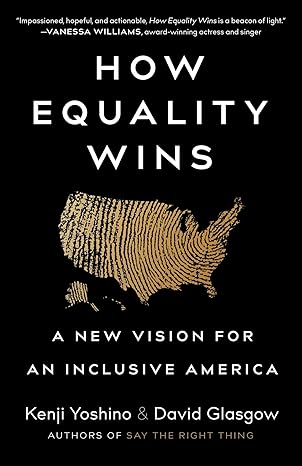

How Equality Wins

I checked this book out of the library 5 months ago. After reading five DEI books one after another circa 2022 I think How Equality Wins is the best DEI book of its kind.

Like I referred to in this blog a long time ago there’s nothing about DEI that is harsh. DEI should simply be equal treatment at work and wherever individuals interact with each other.

Today a Supreme Court ruling has restricted affirmative action in a 2023 case it reviewed.

As the authors of the book illuminate the irony is that when companies like Target end their DEI program’s to appease a president’s order the opposite effect happens: Canceling out DEI doesn’t keep them safe from governmental and anti-DEI lawsuits. Ending DEI results in lawsuits against those companies by BIPOC employees who have been discriminated against.

In fact, no white men have started lawsuits against companies claiming that affirmative action measures have discriminated against the white men. Which was the premise of the anti-DEI elected leaders–that lifting BIPOC staff members harms white male workers.

So really it’s kicking companies like Target where it hurts.

Going from “lifting” to “leveling” the authors advise as follows:

  1. Anonymize assements.
  2. Adopt structured decision-making.
  3. Audit systems for bias.
  4. Create formal mentorship programs.

As well:

“Remove degree requirements from job posting when a college degree isn’t really necessary.

Recruit from a wider range of colleges when a job requires a college degree. List job posting in a variety of formats to reach different audiences ( in other languages too).

Create training programs, ERGs, mentor and internship programs for “first-generation” professionals to give aid in their social mobility.”

What part of Equality Wins for Everyone is not understood when adopting DEI measures?

Not just BIPOC individuals benefit from DEI. Everyone wins when equality is the norm as there’s happier and healthier relationships all around everywhere.

In a coming blog entry I’ll talk about my experience in graduate school taking legal and management courses circa 1999.

In fact historically since the 1990s the Supreme Court has not been on the side of individuals with disabilities and other underrepresented groups in employment.

The Truth About Lower Standards

Lower standards are given everyone it appears and this has a historical precedent:

In college in the 1980s an English professor told me that the term paper topic I chose was too hard. He had me pick an easier one. This discouraged me. Luckily I got a B in the course not a C.

High school students are given no motivation to do their best either today. A White female public school teacher told her Black students: “It’s OK to just get a 75 grade.”

Skill sets for Black White and every other person have to be modeled and taught to kids as early as kindergarten. Why do you think public libraries host story times where children’s librarians read books to babies and toddlers and encourage their parents to read to kids as soon as the child is born?

Makes sense right.

Today there are college graduates who can’t compose a proper English sentence let alone create an effective LinkedIn profile. Some of them have master’s degrees. No kidding.

The solution is NOT to throw the DEI baby out with the bath water to use that expression. I still think the judicious use of affirmative action and DEI workplace policies should be mandated.

Happier healthier workers will be more productive and help their companies generate increased sales. Again I might refer followers to read the book Emotion by Design by Nike’s former Chief Marketing Officer Greg Hoffman. He started as a Biracial art intern at Nike and rose up to be the CMO.

No kidding. If your employees look like your customers and share your fan base’s culture that’s a win-win every time right out of the starting gate.

This is a true sstory.

New Look at DEI and Affirmative Action

In this blog I’m going to write about hot topics to give ideas and insight about a better way of approaching employment issues.

DEI efforts post-hiring in the workplace are really a back-end fix to a front-end problem: no call-backs given to applicants with Black sounding names on resumes.

Research using two identical resumes except for the job seeker’s name have revealed that there are fewer or no calls to the Black candidates who applied.

The solution is to require anonymous resumes. Perhaps a hiring manager when getting resumes uploaded online can have the job seeker remove their name and use a computer-generated number code for each un-named resume to be identified.

The book above talks about this solution. Author Coleman Hughes is against affirmation action whereby the standards are lowered across the board—in classrooms, college admissions, and job hiring—for Black Americans. I had no idea this was the case—I thought only qualified candidates were considered.

In the book Hughes verifies that President Obama lowered the standard for Black Americans to apply for air traffic controller jobs.

He urges a return to Martin Luther King’s vision of our common humanity and a truly color-blind society in terms of race not solely mattering in the scheme of who gets ahead.

Not that I ever thought only White Americans were qualified to hold jobs. Hence my historical perception that we needed to level the playing field.

Hughes urges The End of Race Politics as it has been practiced: the segregation of Americans along color lines and the media darlings’ reinforcing of Black victimhood and the guilt they think White Americans should have.

Let’s not take this bait. No one of any skin color should be made to feel ashamed for the color of our skin. There’s no apology needed for being White. Or Black. Or whatever shade you are.

Hughes calls the current anti-racist proponents ideology about how to help Black Americans “reverse racism.” To Hughes this is a barrier to true racial equity. The woke crowd would be out of business if the media didn’t give these darlings column space and book contracts.

There’s a better way. We can choose our humanity over hate; our dignity over racism wherever the bigotry comes from; our worth over shame.

If we get to be hiring managers we can ask for the resumes we receive to be anonymized. Right.

In coming blog entries I’m going to talk about how individuals with disabilities can get ahead. Intelligence should rule the day not coddling in terms of how any of us are treated.

We can be the first daredevils who use what I call our “self-power” to change the status quo and get ahead via our own efforts.

My first Left of the Dialogue will talk about the new presidential Executive Orders that strip away the rights of those of us with disabilities.

The Truth About DEI

The fact that companies instituted DEI efforts tells us something. In June 2022 I checked out of the library and read 5 DEI business books one right after the other.

I propose that the remedy falls on White coworkers and coworkers of color to come together. The scarcity mentality that exists keeps people competing against each other for self-gain. We should come together because everyone’s in the same lifeboat holding on for dear life.

Any DEI efforts should first be initiated coworker to coworker regardless of our skin color. All coworkers should feel like we have equity or ownership in the outcome of our work projects.

There’s no cause for a coworker to gaslight you or me or to sabotage our work.

It starts with us–with you and me treating every coworker the right way. Banding together on the job to agitate for worker’s rights. It’s like the suspicious packages credo in the NYC subway system that mandates: “If you see something, say something.”

We should not fear retaliation for coming to the aid of coworkers or for fighting against workplace injustice. This issue of being laid off is a real thing though.

Perhaps what we really need along with an emergency fund is a “see you later” account. So that we can speak out and survive financially.

Really DEI begins long before any of us starts our first job. It hinges on widening our circle of friends. Being aware of what’s going on beyond our own lives. Checking a non-fiction book out of the library to read about these topics.

Twenty-five years ago in a Library Management course in graduate school I was already thinking about workplace dynamics. I chose for my term paper to write about how to reward workers for a job well done. How managers could motivate workers.

Giving staff members five 3 x 3 inch sheets of origami paper to “rekindle from burnout” doesn’t cut it.

In coming blog entries I’ll talk about finding a job you’ll love waking up to go to in the morning.

So, You Want to Talk About DEI

Countless anti-racist books have been published–even one listed on the front cover as a National Bestseller. How can that have been a bestseller if Americans voted into office a president who ended DEI efforts in the government.

Coming soon the Supreme Court taking on and trouncing cases involving DEI. The Supremes will rule against DEI efforts just like they ended the protections of Roe v. Wade. It’s only a matter of time.

Acting to obtain a just and fair outcome is everyone’s right and in fact a duty. Are DEI efforts still necessary today? I think DEI efforts fall on White staff standing up for Black coworkers and Black Americans everywhere.

No one wins in a “color-blind” America when a White person tells their friends or others that they don’t see race. Our skin color colors our experiences in life and what we go through navigating daily life. No one should have to “code-switch” to make White people comfortable.

In 1992 I stopped doing business with a racist gym membership director. In 2011 I stopped doing business with a racist real estate agent. Nineteen years later it was the same song and dance.

To remain in denial that racism exists is a mistake. The counter-effort is that each of us can choose what we think about and how we act toward others. Hate is learned or a person chooses to hate.

Each of us can decide to do the right thing. Instead of living solely for self-gain we can come together to advocate for each other’s rights. Instead of protecting our own interests and not caring about people outside our tribe. We can expand our worldview to give others dignity. Instead of seeing everything in life as being about the almighty dollar sign and whether we’re getting our fair share of the Benjamins.

Target halted their DEI efforts. Likely because the current president ended DEI initiatives in the government. You bet Target doesn’t want the president to end giving the company tax breaks if Target kept DEI in place. You want tax breaks you’re going to do what the the president says.

Getting back to whether DEI efforts are still necessary today. In the coming blog entry I’m going to talk about DEI in the workplace. Like everything else I write about I have radical ideas about this topic too.

To end here with the fact: Researchers created two identical resumes to submit to job postings. The only difference was that one resume had a Black-sounding person’s name. The other resume had an obviously White person’s name. Only the White person was called for an interview.

This was circa 2017. I should hope things have changed in 2025. That Black job candidates are getting their feet in the door. The trick is that once any of us of any color or creed gets past those velvet interviewer ropes it’s often game over for employees of any color or creed once we’re on the job.

So, I’m going to talk next about DEI in the workplace. Then in future blog entries write about finding a job you’ll love getting up in the morning to go to.

Black Business Month Books

The books listed in this blog entry should be available at any public library that is not censoring and banning the books people can read and check out with library cards:

Black Faces in High Places: 10 Strategic Actions for Black Professionals to Reach the Top & Stay There by Randal Pinkett.

Black Founder: The Hidden Power of Being an Outsider by Stacy Spikes.

Build the Damn Thing: How to Start a Successful Business if You’re Not a Rich White Guy by Kathryn Finney. (I read this book at least 2 years ago and reviewed it here.)

It’s About Damn Time: How to Turn Being Underestimated into Your Greatest Advantage by Arlan Hamilton.

Twice as Hard: Navigating Black Stereotypes & Creating Space for Success by Opeyemi Sofoluke.

These books are geared to acing jobs the corporate world for those of us who aspire to the C-suite.

Though I’m not a fan of thinking a corporate office job is the only one you should get I understand and respect that for other people they want to excel in a traditional workplace.

The point is that these authors promote navigating the corporate life on your own terms with skills you can learn that they give you. Linked to how they got ahead from a job like film studio gopher to CEO and from food-stamp recipient to venture capitalist.

I say to you readers: Go for It if this is what you want.

The Power of Potential

This book on How a Non-Traditional Workforce Can Lead You to Run Your Business Better should be required reading.

The author lists four issues:

You hire based on interviews. You think great talent is the secret to a great business. Your managers are “good enough.” You fire your worst employees.

The four wins he details instead are:

Every employee feels safe. Accountability is a tool for growth. Your work has purpose. Customers love their experience.

The author and his father chose individuals with autism as their target employees and built a business around this workforce.

The father and son operate two high-profit car washes in Florida that employ only individuals with autism.

In the author’s note up front:

“If you know one person with autism, you know one person with autism.” The quote originates from Stephen Shore, an Autistic self-advocate and professor of special education at Adelphi University.

This holds true for individuals with mental illnesses.

What bugged me about one 3-star review of my first memoir Left of the Dial was that the critic insinuated that recovery was not possible for the majority of people with schizophrenia.

In fact, individuals diagnosed with and living with SZ are a diverse crowd. In a way there’s a spectrum in how the symptoms of the illness manifest in each person.

Not everyone hears voices who has SZ. Others have only paranoia or delusions.

The four wins for the car washes that have autistic workers hold true across disabilities and business types.

Coming up I’ll devote a blog carnival to writing about how having a mental illness can be an asset on the job.

DEI and Disability Inclusion

If you read one DEI book first read Inclusion Revolution by Daisy Auger-Dominguez. It’s the complete guide to the topic.

My favorite DEI book though is the Antiracist Business Handbook by Trudi Lebron. She owns a million-dollar coaching and consulting business. Lebron believes in Just Commerce–a better alternative to Conscious Capitalism.

I’ll talk about DEI in terms of inclusion for individuals with mental illnesses. In order to thrive in an inclusive workplace you first have to get the job to begin with.

In New York City there’s a Queer in Every Career Job Fair. Why isn’t there a (mental illness) Peers in Every Career Job Fair? Or what I would title a Wheels-to-Work Job Fair for those of us who use wheelchairs?

One DEI book I have on my shelf to read talks about DEIB–diversity equity inclusion and Belonging. Again feeling like you belong in a particular workplace is predicated on getting a job with a savvy company that knows promoting diversity and individuality increases sales. The well-being of staff flourishes too.

Michelle T. Johnson easily 10 years ago wrote the book The Diversity Code. What she said: “Honoring individuality is the highest form of achieving diversity.”

In coming blog entries I’ll talk about alternative career paths.

It begs the question: What if you want to work in an office job? Shouldn’t that be an option?

For a lot of us the corporate office environment is not conducive to our mental health. I’m going to talk about getting a job in a public library which I feel should not be overlooked as a viable career.

Jet Fuel for Job Performance

In Working Assets: A Career Guide for Peers I wrote that “Your personality is your jet fuel.”

There’s no better jet fuel to enhance your performance on the job than using your unique perspective to create innovative strategies.

In the chapter Hope for Improvements in the Post-COVID Workplace I reiterated that today more than ever using your personality to find the right career is non-negotiable.

Can you and I afford to settle for less than full inclusion that allows us to show up on our jobs as our spectacular selves?

I’ve come to think that like Trudi Lebron wrote in The Antiracist Business Book “business is personal.” Forming human connections with coworkers and customers is imperative.

We will not thrive at work and traditional capitalism will fail in the post-COVID world if companies continue with business-as-usual.

If we cannot use our gifts and express our individuality on our jobs–two things that help us succeed everywhere we go–then it’s game over.

And the game of capitalism is over in 2022. The economy stalled precisely because the leaders of businesses couldn’t foresee the pandemic coming.

Those of us with the foresight to plan for the unexpected did better.

Peers with mental illnesses would ideally bring compassion for our company’s customers, loyalty to employers who treat us right, and stellar results for the firm.

Surviving and thriving when you have a hardship would give us the ability to persist in using novel approaches to solve a business problem.

The skills and strategies that peers use in our daily lives could indeed be the very Working Assets that will attract a forward-thinking employer.

Coming up a deeper dive into the mechanics of working at a “professional” job.