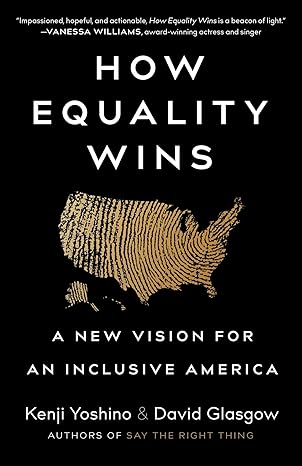
How Equality Wins

I checked this book out of the library 5 months ago. After reading five DEI books one after another circa 2022 I think How Equality Wins is the best DEI book of its kind.

Like I referred to in this blog a long time ago there’s nothing about DEI that is harsh. DEI should simply be equal treatment at work and wherever individuals interact with each other.

Today a Supreme Court ruling has restricted affirmative action in a 2023 case it reviewed.

As the authors of the book illuminate the irony is that when companies like Target end their DEI program’s to appease a president’s order the opposite effect happens: Canceling out DEI doesn’t keep them safe from governmental and anti-DEI lawsuits. Ending DEI results in lawsuits against those companies by BIPOC employees who have been discriminated against.

In fact, no white men have started lawsuits against companies claiming that affirmative action measures have discriminated against the white men. Which was the premise of the anti-DEI elected leaders–that lifting BIPOC staff members harms white male workers.

So really it’s kicking companies like Target where it hurts.

Going from “lifting” to “leveling” the authors advise as follows:

  1. Anonymize assements.
  2. Adopt structured decision-making.
  3. Audit systems for bias.
  4. Create formal mentorship programs.

As well:

“Remove degree requirements from job posting when a college degree isn’t really necessary.

Recruit from a wider range of colleges when a job requires a college degree. List job posting in a variety of formats to reach different audiences ( in other languages too).

Create training programs, ERGs, mentor and internship programs for “first-generation” professionals to give aid in their social mobility.”

What part of Equality Wins for Everyone is not understood when adopting DEI measures?

Not just BIPOC individuals benefit from DEI. Everyone wins when equality is the norm as there’s happier and healthier relationships all around everywhere.

In a coming blog entry I’ll talk about my experience in graduate school taking legal and management courses circa 1999.

In fact historically since the 1990s the Supreme Court has not been on the side of individuals with disabilities and other underrepresented groups in employment.

The Truth About Lower Standards

Lower standards are given everyone it appears and this has a historical precedent:

In college in the 1980s an English professor told me that the term paper topic I chose was too hard. He had me pick an easier one. This discouraged me. Luckily I got a B in the course not a C.

High school students are given no motivation to do their best either today. A White female public school teacher told her Black students: “It’s OK to just get a 75 grade.”

Skill sets for Black White and every other person have to be modeled and taught to kids as early as kindergarten. Why do you think public libraries host story times where children’s librarians read books to babies and toddlers and encourage their parents to read to kids as soon as the child is born?

Makes sense right.

Today there are college graduates who can’t compose a proper English sentence let alone create an effective LinkedIn profile. Some of them have master’s degrees. No kidding.

The solution is NOT to throw the DEI baby out with the bath water to use that expression. I still think the judicious use of affirmative action and DEI workplace policies should be mandated.

Happier healthier workers will be more productive and help their companies generate increased sales. Again I might refer followers to read the book Emotion by Design by Nike’s former Chief Marketing Officer Greg Hoffman. He started as a Biracial art intern at Nike and rose up to be the CMO.

No kidding. If your employees look like your customers and share your fan base’s culture that’s a win-win every time right out of the starting gate.

This is a true sstory.

Rocking Authenticity At Work

This radical idea struck: To write in here about the competitive advantage you have in not conforming.

Albert Einstein was a genius. Was he hanging out at the water cooler all day chatting with colleagues? Likely not.

Danny Rojas the Container Store’s Sr. Manager of Talent Acquisition spoke on this theme in an interview on the Container Store website:

Re: the fallacy of blending into the company culture and the benefit of a DEI ethic:

Rojas thinks that your being different–your individuality–can improve the culture of the company you work at.

How can you and I best add to the dynamic: By remembering that “not conforming” is not a free pass to acting convfrontational with coworkers.

I have a definite idea about the old chestnut of “acting true to yourself.” I believe everyone living on earth in this lifetime is here to experience karma. It’s not the punishment for prior sins. It’s the gaining knowledge of what you didn’t know before–like the evolution of your soul animated in this body and mind.

As not everyone we interact with is pleasant or dandy I think accepting others as they are and letting them be themselves is the key to inhabiting planet Earth with less friction and animosity among those of us with opposing ideologies.

Expecting a person to show up as their authentic self is key. This should be the playbook for interacting with people whose worldview is different from ours:

I accept and affirm how others feel. I make them feel seen and heard. I uphold that they are safe to express what they think and feel in my presence. I honor and celebrate their individuality.

Right. Not everyone else is going to operate this way–and not often likely toward a person living with a disability. Yet this is the ethic I think we should strive for.

At work you’ll rub elbows with the world. Though I failed big time working in the corporate and law offices I credit that early first experience with exposing me to coworkers from different walks of life.

Acceptance should be reciprocal: I allow you to act true to yourself and you allow me to act true to myself.

What about when a person has a mental health issue and they’re employed? Coming up my extended take on disclosure.