New Look at DEI and Affirmative Action

In this blog I’m going to write about hot topics to give ideas and insight about a better way of approaching employment issues.

DEI efforts post-hiring in the workplace are really a back-end fix to a front-end problem: no call-backs given to applicants with Black sounding names on resumes.

Research using two identical resumes except for the job seeker’s name have revealed that there are fewer or no calls to the Black candidates who applied.

The solution is to require anonymous resumes. Perhaps a hiring manager when getting resumes uploaded online can have the job seeker remove their name and use a computer-generated number code for each un-named resume to be identified.

The book above talks about this solution. Author Coleman Hughes is against affirmation action whereby the standards are lowered across the board—in classrooms, college admissions, and job hiring—for Black Americans. I had no idea this was the case—I thought only qualified candidates were considered.

In the book Hughes verifies that President Obama lowered the standard for Black Americans to apply for air traffic controller jobs.

He urges a return to Martin Luther King’s vision of our common humanity and a truly color-blind society in terms of race not solely mattering in the scheme of who gets ahead.

Not that I ever thought only White Americans were qualified to hold jobs. Hence my historical perception that we needed to level the playing field.

Hughes urges The End of Race Politics as it has been practiced: the segregation of Americans along color lines and the media darlings’ reinforcing of Black victimhood and the guilt they think White Americans should have.

Let’s not take this bait. No one of any skin color should be made to feel ashamed for the color of our skin. There’s no apology needed for being White. Or Black. Or whatever shade you are.

Hughes calls the current anti-racist proponents ideology about how to help Black Americans “reverse racism.” To Hughes this is a barrier to true racial equity. The woke crowd would be out of business if the media didn’t give these darlings column space and book contracts.

There’s a better way. We can choose our humanity over hate; our dignity over racism wherever the bigotry comes from; our worth over shame.

If we get to be hiring managers we can ask for the resumes we receive to be anonymized. Right.

In coming blog entries I’m going to talk about how individuals with disabilities can get ahead. Intelligence should rule the day not coddling in terms of how any of us are treated.

We can be the first daredevils who use what I call our “self-power” to change the status quo and get ahead via our own efforts.

My first Left of the Dialogue will talk about the new presidential Executive Orders that strip away the rights of those of us with disabilities.

Brain Doping

Last week I read on the internet about an alarming trend:

Office workers engage in “brain doping” by taking ADHD pills like Adderall to enhance their performance. The drugs enable these staff members to achieve superhuman output on the job.

Just. Why. Not ever have I been a fan of getting a job in a corporate office. Unless you are like my friend Robin. He obtained an MBA and had a 20-year career in business.

A corporate career might suit you and other followers. I wouldn’t entirely rule out working in an office. Provided management treats employees right.

The fact that people are brain doping on the job shows how insidiously harmful late-stage capitalism is when businesses put profits before people. Then workers put earning money as their reason for working and brain doping. Getting ahead in corporate America should not come at the expense of our sanity.

About two or three years ago a former Amazon office employee published an expose of her time working at that company. The book was titled Exit Interview.

Amazon expects office workers to come in on Saturdays when their managers call them on the phone that morning.

This is unlivable. This is unworkable. The Exit Interview author wrote that after working at Amazon for 12 years she couldn’t recognize herself in the mirror.

In the coming blog entry I’m going to write in more detail about the insanity of businesses–and even non-profits–demanding total allegiance at the expense of our mental and physical health.

I urge followers not to engage in brain doping.

Building a Better World

This is the last entry in the 3-part blog carnival.

Jose Andres and his World Central Kitchen volunteers show up after hurricanes like Maria in Puerto Rico and in conflict zones Feeding the Hungry.

Andres and his crew have done what the Red Cross and U.S. government could not. In the Middle East they built a solid usable jetty. The U.S. spent $300 million building a temporary floating structure nearby that collapsed.

Andres didn’t think he could feed the millions who needed food. His game plan should be replicated by us: Start with one subgoal at a time.

Andres knew that the people living in those other countries were the best experts to tell him what to do when the World Central Kitchen staff showed up.

In fact, Andres is against hosting Zoom meetings to figure out the plan. Meet a person in person is his belief.

Change the Recipe is only 175 pages. It should be bought to refer to time and again for a refresher in hope that a single individual can alleviate the suffering in the world. Each of us can start volunteering in our corner of the world for the cause we’re committed to.

Asking the recipients of help what they need is far better than thinking you know what they need and pre-assembling a care package to give them.

Even before I published Working Assets the career guide I had at least three peers read the manuscript to tell me what they thought of it.

Living life without taking risks is no life to live if you ask me. Andres saw the need that creating World Central Kitchen could fill better than others could fill that need.

This is the key to succeeding: Filling a need your target market has and being the best at what you do.

Breaking Some Eggs

Change the Recipe by Jose Andres talks about how to build a better world by breaking some eggs. In a way breaking the rules by breaking eggs is also the way to get ahead for yourself. In turn each of us should think about breaking those eggs to help others succeed.

Creative minds can achieve more for ourselves by collaborating with others and helping them out along the way. Lifting other individual’s boats rises the tide in our favor too.

In Change the Recipe Jose Andres the chef has a chapter titled Build Longer Tables Not Higher Walls.

The fact that bellicose men rule the world and start wars against each other is not something we should accept as the normal operating business of government.

Andres at the end of this chapter states:

“When you share a meal with someone, or lots of people, you learn more and can help more. And helping people rebuild their lives where they are is far more successful than building walls to keep us apart.”

So-called “migrants” flee their countries and come to America or places like Italy and Greece because civil and other wars have displaced them.

The World Central Kitchen that Jose Andres founded steps in to feed the people where they are. The WCK helps those individuals feed themselves doesn’t just give them a handout.

One brilliant solution Andres had was to make sandwiches when hot stoves weren’t available. Andres bought the sandwich ingredients from a local farmer at a market.

Change the Recipe gives “recipes” for how to build a better world. Each of us one person at a time can contribute mighty effort by “breaking some eggs” in our own way.

The fact that each of us is just one person shouldn’t deter us from trying to build this better world for others and for ourselves too.

Early on in recovery our goal should be bettering ourselves. Then with our feet planted on this ground we can aspire to help others. 

Changing the Recipe

Coming up I’m going to post a 3-entry blog carnival dedicated to a new book published in April that I think everyone should read.

Reading books like Change the Recipe has always been a gift of joy and inspired living for me.

In all ways and from disparate sources I glean the information I can use to better myself. In turn I seek to help readers followers and audience members better themselves by sharing this information.

Maybe my life ethic shouldn’t be a surprise as I obtained a master’s in library and information science decades ago.

Like Mary Oliver asked famously in a quote:

Tell me what is it you plan to do with your one wild and precious life?

Finding out and going and doing what calls out to you could help a person Enjoy Life when they struggle.

I chose to devote my life to public service.

The goal I have for reviewing books in here is to inspire followers that the keys to self-development are right in front of our eyes.

Read on for a review of the latest book that changed my life.

Case Study: Ashley Smith

Case Study: Ashley Smith

Altruistic and Ambitious Advocate

In this blog I’m going to feature Case Studies of peers living in recovery who are role models for forging our own path in life and succeeding at a career. Our first Case Study will be in 3 parts to cover the full story.

In 2008  Author Advocate Ashley Smith started her anonymous Overcoming Schizophrenia blog. Since then she’s used her real name to blog and publish 7 books. I met her at a film screening for a video on recovery that she was featured in.

Ashley studied business in college before her breakdown. Altruistic while ambitious she’s not afraid to share her story to give peers a shot of confidence to pursue our own goals unabashedly.

I’m taken in by her choice of the purple outfit for the cover of her new book. Purple is a color that symbolizes royalty and spirituality. How fitting for a peer whose devotion to Spirit and using affirmations has helped her get ahead.

Part One:

It’s been 17 years since you first clicked publish on your first blog entry. What exactly enabled you not to quit and keep going?

My blog, Overcoming Schizophrenia, started as an online diary about my diagnosis and to recall my experiences as an advocate. Now I blog for others wholeheartedly. I aim to be a beacon of hope and offer a sense of direction and motivation to keep pressing onward.

However, it’s hard to be consistent with blogging for me but I’ve challenged myself this year (2025) to write one blog article each week. I want to continue the conversation on ways to trump the stigma of mental illness. Further assisting peers and caregivers on their paths to wellness. I’ve grown a lot in my recovery and want to share my life story. Leading others to understand and believe that a fulfilling life in recovery is possible.

What can you tell peers who have a dream or goal of their own just starting out?

Recovery is a lifestyle and your goals are attainable. Remember to take small steps until you gain momentum and are comfortable increasing your progress. Aim to develop a routine to maintain balance between self-care and your responsibilities. Self-care is essential to managing ourselves. To be our best and well to tackle work and goals full force.

Talk about the role that support plays in our lives—either through our family, friends, treatment providers, or a chosen family or others we interact with.

Having a support system is vital to staying committed to my wellbeing. My family plays significant role in my wellness. They’ve been my foundation of strength. They keep me accountable and give me the support I need to keep pressing forward.

I’ve worked with the same treatment team; my doctor for over 12 years and my therapist for over eight years. They understand my needs and are dependable during crisis.

I have a lot of peer support too. Participating in organizations such as NAMI (National Alliance on Mental Illness) and the CURESZ Foundation. NAMI allows me to partake in different leadership roles. I’ve facilitated workshops and support groups.

I encourage you to get involved in a group that you can grow with. A place outside of the home but feels like home. This type of support is challenging to find but consider your church, 12 step support groups, local NAMI affiliate, and organizations where you might volunteer to gain assistance and someone to confide in. Everybody needs support to survive and thrive in life.

Acing a Job Interview

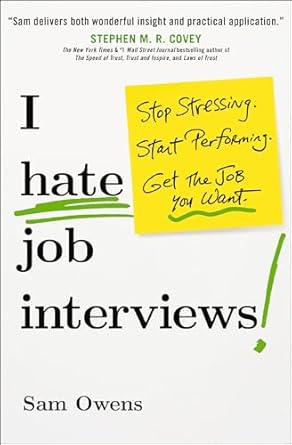
The new book pictured is the ideal primer on how to ace the interview so that you get a job offer. I Hate Job Interviews was published this year. So It was too late to include this guide in my book Working Assets. In the updated career book I hope to publish I will refer to this.

Each chapter segues into the coming chapter so the book should be read from the first chapter to the last. I checked this book out of the library.

Employers commonly use interviews to determine who to hire. Other career book authors rail against using interviews. They recommend giving a job candidate a work project to turn in as a sample.

Yet still hiring managers use interviews to decide who to give a job offer. This won’t change anytime soon.

One interview question listed in the new book is “What kind of flavor would you choose if you were going to sell a new donut?”

The author Sam Owens thought salted caramel and Godiva chocolate options would be great answers. From the standard to the wacky everything you experience on an interview is covered in this book.

The fact that upwards of 85 percent of the customers I helped create resumes got job offers is not all because of my effort. Once those people got the job interview they wowed the hiring manager.

So that reading a book like I Hate Job Interviews! should be required in tandem with other strategies.

Surviving Capitalism

I checked out of the library the book in the photo above. The author Madeline Pendleton is the Founder & CEO of Tunnel Vision. The company is a million-dollar online clothing seller where Pendleton pays herself and every other employee the exact same livable salary.

According to Pendleton: productivity increased 40 percent when Microsoft Japan implemented a four-day work week without reducing pay for its employees.

In fact: “The more you work, the less accurate you are.” Overwork causes ill health too.

In I Survived Capitalism:

“One study by University College London found that employees working a 55-hour week faced a 33 percent increased risk of stroke. In another study, the U.S. Centers for Disease Control and Prevention found working 61-70 hours per week increased the risk of heart disease by 42 percent.”

Madeline Pendleton was a teen who gravitated to the punk rock culture. Today in the Tunnel Vision office you can hear music by the band Crass on the speaker.

Pendleton tells the reader:

“Start with revolutionary optimism. Believe a better world is possible. It’s the first step to getting there.”

Now go out and buy the book since I’ve quoted it in this review. Geared to Gen Z and Millennials it’s also for others who could use a shot of empowerment to opt out of chasing bigger better more and not getting hoodwinked by materialism into thinking capitalism as it exists today is acceptable.

Coming of age in the 1980s I too was spellbound by the punk rock ethos. A disc jockey on FM radio in college I played the Dead Kennedys and other radical bands on air.

Like Pendleton does I too believe a better world is possible. I’ve always been an optimist.

The difference is that like Pendleton asserts happiness in life comes down to having what you think is “enough.”

You could be a millionaire and still not be happy.

The root of what I’m attempting to do is create economic justice for individuals with disabilities like mental illnesses who too often are forced to live in poverty collecting government checks.

Should you be compelled to want to make things better you can do so in your own inimitable way too. We cannot let fear of what others will think of us stop us from acting to make possible the better world we think is possible.

One person’s small actions and another person’s small actions and everyone’s small actions working together can create the change we want to see.

Awakenings

I’m taking a detour to promote the new book that can be bought on Amazon for only $14.99. Reading the stories of struggle and triumph could give you ideas about tactics to use so that you can flourish on and off the job.

The book above features the first-person accounts of 28 individuals diagnosed with schizophrenia who have recovered. Plus, credible information on AOT, ACT, marijuana use and psychosis, treatment and medications used.

My recovery story is featured at number 5 in the book. It’s the shortest in length recovery story. The other stories have longer pages.

The other survivors went through years and years of hell and heartache. Getting the right treatment right away can result in a better outcome quickly. Yet for those of us who struggle long-term this book shows that hope for a better life is possible at any time in your recovery.

There are as many versions of recovery as there are people living in recovery. Like a thumbprint our lifestyles are unique and can be full and robust in their own way.

The point is not to compare yourself to other people. The grass might be greener on the front lawn over there. Inside the house it’s a hot mess where you can’t see it.

In coming blog entries I will talk more about coping with pressure on the job.

Gold Stars: Boon or Boondoggle

I checked the above book out of the library.

What if we took the off ramp on the high-stress mainstream highway?

What if you joined me in living life Left of the Dial?

The New Alt-American Dream is alive and well.

For those of us with the courage to veer off the beaten career path there’s joy, meaning, purpose, and fulfillment in serving others. More on this in the coming blog entry.

Right now the myth to bust:

We should stop inculcating in teenagers that they must get on the freeway to success early in life with high SAT scores and pedigrees from elite colleges.

No young person should have to know by 18 what they want to do with their life. Play and fun is warranted. Not doing community service solely to get into the right university.

In here I reviewed the book Late Bloomers about how those of us who didn’t take this “conveyor belt” ride to early achievement have traits that enable us to succeed in our older years.

Recently I read Project 333. The author of that book wrote that she spent 20 years in a marketing job. Racked up credit card debt buying clothes she never wore with tags still attached.

Courtney Carver stayed in that career because she thought the job was what she had to do to prove her worth in society and get ahead. Along the way she was diagnosed with MS–multiple sclerosis.

Too often we’re afraid to do what we really want. We succumb to chasing fame or fortune so grind away in a “money pit” job.

Or the ideal work would come with a lower salary. That’s why in my career guide Working Assets I talk about getting a second source of income while you clock in during the day at a job you like.

In the next blog entry I’ll talk about a beautiful job for dreamers who want to do what they dream of.