Acing a Job Interview

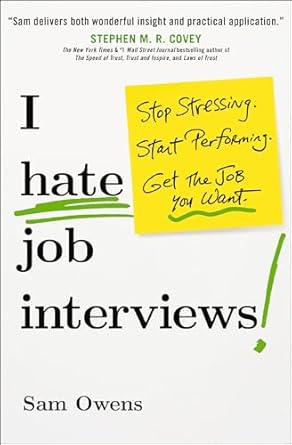
The new book pictured is the ideal primer on how to ace the interview so that you get a job offer. I Hate Job Interviews was published this year. So It was too late to include this guide in my book Working Assets. In the updated career book I hope to publish I will refer to this.

Each chapter segues into the coming chapter so the book should be read from the first chapter to the last. I checked this book out of the library.

Employers commonly use interviews to determine who to hire. Other career book authors rail against using interviews. They recommend giving a job candidate a work project to turn in as a sample.

Yet still hiring managers use interviews to decide who to give a job offer. This won’t change anytime soon.

One interview question listed in the new book is “What kind of flavor would you choose if you were going to sell a new donut?”

The author Sam Owens thought salted caramel and Godiva chocolate options would be great answers. From the standard to the wacky everything you experience on an interview is covered in this book.

The fact that upwards of 85 percent of the customers I helped create resumes got job offers is not all because of my effort. Once those people got the job interview they wowed the hiring manager.

So that reading a book like I Hate Job Interviews! should be required in tandem with other strategies.

Video Conference Tactics

The Zoom boom experienced during the pandemic has altered how people work too. My go-to Vault website offers detailed tips and tactics.           

The top takeaway: using lighting and location to your advantage. You’ll want to access your computer in a room free of distractions like loud noises, running children, and cluttered background.

Dressing in formal business attire from head to heel will set the tone for how you interact with your potential boss or actual supervisor and coworkers. No pajamas from the waist down please.

Look into the camera not down. You want your face to be visible. It should appear that you’re making eye contact with the other person.

Resist uploading a photo as a background. Ideally, the view of the room behind you will be of a white wall with minimal bright or other objects in the room.

Experiment beforehand to adjust the lighting and background. Verify that your computer video and audio and webcam are working properly. You want others to see your face as well as hear you speak.

Again, smiling appropriately will go a long way as well as speaking in a clear slow voice. Rushing through your presentation will be obvious. People will comment among themselves afterward that you were talking too fast. They might not tell you this.

Brushing up on your public speaking skills can help you do well with video conference platforms online. One thing no one else has talked about is what happens when the session has ended, and people click Leave. Some of you might stay on the video and chat informally among yourselves.

Keep this “off-the-record” conversation professional. You can use this chat to talk about common interests you share with your coworkers outside of the job. Refrain from divulging sensitive information here that others shouldn’t be privy to. Maybe you want to talk about a new recipe you’re going to cook for dinner.

I’ve stayed online with two coworkers after a Microsoft Teams meeting. This is the modern day equivalent of gathering at the water cooler in the office. Some companies offer Zoom online “Happy Hours.”

One last tip: You don’t have to click on your webcam’s icon on your computer desktop beforehand to turn on the webcam to join an online meeting. Simply click “Join” on the link you’re given to the MS Teams or Zoom or other conference. Your face should then appear in the video.

Tackling a Telephone Interview

Today a telephone interview is a screening interview to rule out or verify whether the hiring manager thinks you’re the perfect candidate for an in-person meeting.

In the time of the COVID-19 outbreak working remotely from home, using Zoom and Microsoft Teams online to conduct meetings, and being interviewed via telephone were all common practices. Expect to see a rise in telephone interviews and Zoom meetings.

Dress in business clothes when you’re being interviewed on the phone. A study revealed that individuals who dress this way “could think faster on their feet and had more creative ideas.” These skills are coveted on the job.

A telephone screening is a way to determine if you’re the right fit for the company. Talk up your unique skills, abilities, and strengths. You should’ve researched the firm to uncover the hiring manager’s hidden pain in filling a need the business has. Give specific examples of how you think you can come up with a solution.

Smile when talking on the phone to convey energy and sound more upbeat. Remember that like with an in-person meeting you have the right to “interview the interviewer.” Ask questions. You can use the telephone chat to rule out or verify that this is the ideal company for you.

Today a video interview is more common. Up next tactics for a Zoom meeting.