Loving Your Job is Possible

At least three non-fiction books rail against the myth that you can find a job you love:

Work Won’t Love You Back

Do What You Love (And Other Lies)

We are All Fast Food Workers Now

In my career guide I made the distinction I want to reiterate here:

You CAN love your job even if you’re not doing what you love to do like bake cookies.

You might like to cook. That doesn’t mean you should become a chef. Maybe you’ll bake pies to take to work to share with coworkers. Or have a side business selling those pies to earn extra cash.

I happen to love my job. I didn’t have this career until I turned 35. Proving that it’s not too late to pivot start over or even begin a job for the first time.

A guy I met 15 years ago told me he decided at 55: “Enough! I want to get a job!”

Then there’s the story of the gray-haired lady in her sixties who attended library school with me. Other people were ending their lives and she decided it wasn’t over for her.

In coming blog entries I’m going to talk about workplace woes and wonders. Using a sense of humor to talk about these topics.

Again: you can love your job even if it doesn’t involve your wildest passion of what you like to do.

Outside of the workplace is where we shouldn’t skimp on doing what thrills us every day.

The BrAIn Drain

A friend used ChatGPT to create a poem for me one year ago. The poem was great. Though I had hoped he wrote it on his own. I’m no fan of outsourcing your intelligence.

AI or Artificial Intelligence is here to stay. It generates “hallucinations” that is false information and contains biases.

Though I’m no fan of AI at the end of this blog entry I’ll link to a Vault article on AI software you can use to create a resume. A person I interacted with 2 years ago used AI to create a resume that got them a job interview. They were offered the job.

When using AI to create a resume this way you should absolutely customize the resume from there instead of merely doing a cut-and-paste of what the AI software spits out.

Using AI is taking us in the wrong direction relying solely on using interviews instead of requiring candidates to give a work sample or do one-day trial work.

The risk I see is that using AI job seekers will be creating identical resumes when applying for jobs.

AI is being co-opted in every business arena. It can produce misleading images and violate copyright. Students are using AI to create term papers.

Sadly I likely will be forced to use AI even though I’d rather not. I obtained an MS in library and information science with a 3.89 GPA. You can see that I prize natural intelligence then.

It’s a slippery slope we’re going down with the extended lack of using our own originality and creativity to innovate new ideas, products, and services.

I’m not against the careful and judicious use of AI to create content and decide what to do. It’s just that the industry should be regulated precisely because of the existence of AI=generated bias and false information.

Here’s the vault article on the Best Free AI Resume Builders.

Acing a Job Interview

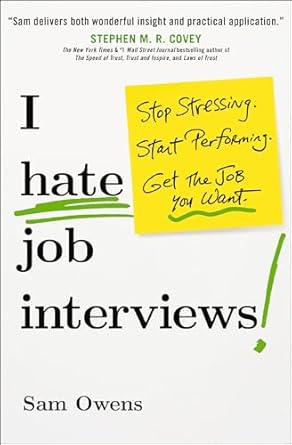
The new book pictured is the ideal primer on how to ace the interview so that you get a job offer. I Hate Job Interviews was published this year. So It was too late to include this guide in my book Working Assets. In the updated career book I hope to publish I will refer to this.

Each chapter segues into the coming chapter so the book should be read from the first chapter to the last. I checked this book out of the library.

Employers commonly use interviews to determine who to hire. Other career book authors rail against using interviews. They recommend giving a job candidate a work project to turn in as a sample.

Yet still hiring managers use interviews to decide who to give a job offer. This won’t change anytime soon.

One interview question listed in the new book is “What kind of flavor would you choose if you were going to sell a new donut?”

The author Sam Owens thought salted caramel and Godiva chocolate options would be great answers. From the standard to the wacky everything you experience on an interview is covered in this book.

The fact that upwards of 85 percent of the customers I helped create resumes got job offers is not all because of my effort. Once those people got the job interview they wowed the hiring manager.

So that reading a book like I Hate Job Interviews! should be required in tandem with other strategies.

HERO Traits

In reading one of the burnout books I alighted on the concept of HERO traits. Those of us who possess these traits are thought to do better on the job and in life.

The HERO traits are:

Hope

self-Efficacy

Resilience

Optimism

Gratitude

Empathy

Mindfulness

Social media algorithms purposed keep people on sites like Facebook and X (formerly Twitter) using metrics designed to keep people antagonistic towards each other.

I say lay off getting sucked into these agents of acrimony. Try asking a real live person out for coffee. To talk about what makes them tick. To have fun. Instead of wallowing in online fury.

Red and blue make Purple. Purple is a gorgeous color. United we stand. Divided we fall.

Why not devote time to using the HERO traits to better ourselves.

We can also use these traits interacting with others like coworkers.

Surviving Capitalism

I checked out of the library the book in the photo above. The author Madeline Pendleton is the Founder & CEO of Tunnel Vision. The company is a million-dollar online clothing seller where Pendleton pays herself and every other employee the exact same livable salary.

According to Pendleton: productivity increased 40 percent when Microsoft Japan implemented a four-day work week without reducing pay for its employees.

In fact: “The more you work, the less accurate you are.” Overwork causes ill health too.

In I Survived Capitalism:

“One study by University College London found that employees working a 55-hour week faced a 33 percent increased risk of stroke. In another study, the U.S. Centers for Disease Control and Prevention found working 61-70 hours per week increased the risk of heart disease by 42 percent.”

Madeline Pendleton was a teen who gravitated to the punk rock culture. Today in the Tunnel Vision office you can hear music by the band Crass on the speaker.

Pendleton tells the reader:

“Start with revolutionary optimism. Believe a better world is possible. It’s the first step to getting there.”

Now go out and buy the book since I’ve quoted it in this review. Geared to Gen Z and Millennials it’s also for others who could use a shot of empowerment to opt out of chasing bigger better more and not getting hoodwinked by materialism into thinking capitalism as it exists today is acceptable.

Coming of age in the 1980s I too was spellbound by the punk rock ethos. A disc jockey on FM radio in college I played the Dead Kennedys and other radical bands on air.

Like Pendleton does I too believe a better world is possible. I’ve always been an optimist.

The difference is that like Pendleton asserts happiness in life comes down to having what you think is “enough.”

You could be a millionaire and still not be happy.

The root of what I’m attempting to do is create economic justice for individuals with disabilities like mental illnesses who too often are forced to live in poverty collecting government checks.

Should you be compelled to want to make things better you can do so in your own inimitable way too. We cannot let fear of what others will think of us stop us from acting to make possible the better world we think is possible.

One person’s small actions and another person’s small actions and everyone’s small actions working together can create the change we want to see.

Awakenings

I’m taking a detour to promote the new book that can be bought on Amazon for only $14.99. Reading the stories of struggle and triumph could give you ideas about tactics to use so that you can flourish on and off the job.

The book above features the first-person accounts of 28 individuals diagnosed with schizophrenia who have recovered. Plus, credible information on AOT, ACT, marijuana use and psychosis, treatment and medications used.

My recovery story is featured at number 5 in the book. It’s the shortest in length recovery story. The other stories have longer pages.

The other survivors went through years and years of hell and heartache. Getting the right treatment right away can result in a better outcome quickly. Yet for those of us who struggle long-term this book shows that hope for a better life is possible at any time in your recovery.

There are as many versions of recovery as there are people living in recovery. Like a thumbprint our lifestyles are unique and can be full and robust in their own way.

The point is not to compare yourself to other people. The grass might be greener on the front lawn over there. Inside the house it’s a hot mess where you can’t see it.

In coming blog entries I will talk more about coping with pressure on the job.

What Burnout Is

Months ago I listened to a webinar on burnout and how to alleviate this type of compassion fatigue.

Stress is the perceived threat to one’s mind, body, spirit, or emotions. The anticipation about a stressor often comes out of nowhere without an obvious trigger.

Pinpointing the root of the stress is the key to developing strategies to manage what’s going on.

The definition of burnout is:

“A state of physical, mental, or emotional exhaustion resulting from chronic stress. It is characterized by feelings of alienation, indifference, and low self-regard; a loss of interest in work, and an inability to perform one’s day-to-day job duties.”

Burnout is often caused by a feeling that work is out of control. This stress can affect you over the longer term.

How to prevent compassion fatigue and attendant burnout:

  1. Take a break.

2. Say no to a request in a positive way: “Sorry my plate is full.”

3. Remember that you can’t answer every question. Sometimes you don’t have an answer.

4. Obtain skill training like listening to a burnout webinar.

5. Focus on proper rest and nutrition.

6. Remember that you alone don’t bear the brunt of “fixing” yourself or the situation. Empathic supervisors keeping the lines of communication open hold another key to alleviating burnout.

In the coming blog entry I’ll give my ideas for coping with stress and pressure on the job.

Practicing Dolce Far Niente

The Italian ethic of dolce far niente is in English words “the sweetness of doing nothing.” Italians invented stopping to smell the roses.

I have long been entranced with my culture’s practice of taking time going about things “piano-piano” which is slowly-slowly like the tour guide in Rome told us to walk through the historic streets.

Having my health wrecked acting as a caregiver I had to prioritize my wellbeing in every area of my life not just by mitigating the effects of doing unpaid emotional labor for a family member.

Research proves that by working insane hours at a job a person’s level of productivity goes way down. The opposite of what you would think happens when we labor past 5:00 at the office to “get things done.”

Sadly, alternative careers to those in corporate offices often come with a lower salary and the risk of compassion fatigue with burnout. No one is immune from the risk of burning out.

How have I built ongoing rest into my life on and off the job? At the height of COVID forced indoors in lockdown I took naps in the afternoon long before reading Rest is Resistance.

Today after I work out in my home gym I lie in bed for an hour after each session and sometimes fall asleep then.

As best I can I try to go to bed between 9:00 to 10:30 p.m.

Tricia Hersey in Rest is Resistance ends her book with the call to use our imagination to create the future we want to have for ourselves. While napping ideas come to her.

The plots to novels come to me in dreams at night when I’m sleeping. I wake up, grab my pen and notebook and write down the details about the characters, plot, and book title.

I have also solved real-life problems by paying attention to the events in dreams and what those dreams are telling me to do.

Rest is not a luxury. It’s required for everyone living in America today. Especially for those of us who aspire to get a full-time job.

Coming up soon a dive into the perils of scrolling social media for hours. I haven’t ever been a fan of social media like Facebook. (hint: it’s more likely anti-social.)

Resting from Burnout

In future blog entries down the road I will talk about how we can have a life of health, wealth, and happiness. The idea of wealth today lies in having abundance. Regardless of our finances we have a cornucopia of skills, strengths, and abilities that can help us live our lives well.

The book above I read in 5 hours straight. I recommend that you rest between reading the chapters in Rest is Resistance.

The author is the founder of the Nap Ministry. Her book is short. Her life’s work of righting the injustice of capitalist “grind culture” is rooted in Black Liberation.

In the book Hersey attests that resting as a form of resistance is for everyone in society not just Black Americans.

The fact is every worker of every color and creed should not live to toil in servitude to corporations that put profits before people.

We should create our own value system that prioritizes being not doing as the indicator of a person’s worth. The myth of needing to be productive at all times I haven’t been a fan of either.

Hersey advocates for taking naps. She is against influencer-peddled methods for resting that only perpetuate that you should “rest up” to be able to get more done the next day.

Hersey is against capitalism as it exists today as it was founded through the forced inhuman 24/7 labor of enslaved Africans on plantations.

In the coming blog entry I will talk about my firsthand experience with napping and resting and taking breaks. To show you how I as an Italian born in America prioritized my mental and physical health long before reading Rest is Resistance.

Offsetting Burnout

I attended a Zoom burnout session. In future blog entries I’ll talk about what I learned there.

While burnout is NOT the employees fault some things can help alleviate the stress that are person-centered as referred to in The Burnout Challenge:

Staying Healthy

Getting enough sleep

Relaxing

Understanding oneself

Developing new skills (on the job)

Getting away from the job

Getting social support

In terms of developing new skills on the job circa 2008 I took training to help customers create resumes and conduct job searches.

This made all the difference in sparking joy at work.

It can be tough when staff feel they can’t approach management to get things done in terms of the 6 causes of burnout. What if the upper echelon doesn’t see fit to change things?

A new 2023 book at the library titled Exit Interview was a memoir and expose of working in the corporate Amazon office. The woman author said she had in effect sold her soul: After 12 years working in that environment she no longer recognized the person in the mirror.

I buy things on Amazon that I can’t find locally or anywhere else. I admire Jeff Bezos for how he transformed Amazon from an online bookseller in 1997 to the Marketplace of the World. However I’m NOT a fan of how Amazon treats its workers. Warehouse staff are given health insurance precisely because their jobs in the warehouses cause ill health.

Sadly the cure for burnout is not job-hopping if you risk going “out of the frying pan into the fire.” The next job you get could be like reliving the old job.

I will talk further in future blog entries about visionary ideas for making the workplace a better place to work.